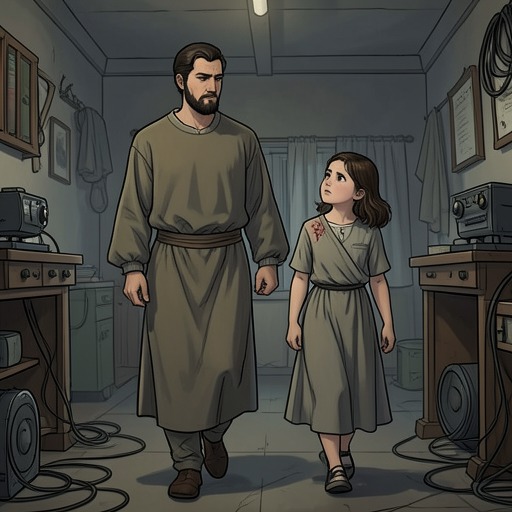
Ah Zi’s Severe Injury and Recovery
Demi-Gods and Semi-DevilsAh Zi’s severe injury and recovery transform an accidental act of violence into a prolonged period of dependence, care, and uneasy closeness with Xiao Feng. The injury follows her attempt to prevent Xiao Feng from killing her father, Duan Zhengchun: she disguises herself as him and receives the palm strike meant for him. Left unable to move, she survives, but her recovery is slow and incomplete, testing Xiao Feng’s remorse and reshaping their daily lives.
The Injury and Its Cause
At the bluestone bridge, Xiao Feng discovers that the figure he has struck is not Duan Zhengchun but Ah Zi, whose disguise has concealed her identity. The revelation comes only after he notices that the body in his grasp feels far lighter than expected and wipes away the material used to alter the face. By then, his palm strike has landed with full force. Ah Zi’s intervention has stopped him from killing her father, but it has left her gravely injured.
Xiao Feng responds with immediate horror and self-condemnation. He kneels beside Ah Zi, recognizes that his strength has caused an injury he believes cannot be undone, and turns his anger against himself rather than her. As she asks him not to harm himself, he struggles to understand why she concealed her plan. Ah Zi explains that she had heard her parents lament having abandoned her and her younger sister, and knew that Duan Zhengchun was her father. She had pretended to be ill, then used disguises to cancel the appointment and take her father’s place.
Her choice arose from a conflict she considered impossible to resolve openly. She wanted to remain with Xiao Feng, but believed he would not abandon revenge for the deaths of his five relatives merely because she asked him to spare her father. She therefore acted without telling him. Xiao Feng later keeps transferring his internal energy to her, but she dies in his arms before his efforts can save her. Her death is the beginning of the extended aftermath of the injury: grief and guilt become the conditions under which he will later care for her younger sister.
From Grief to Care
After Ah Zi dies, Xiao Feng carries her through the wilderness and remains beside her body at the Square Bamboo Forest. He continues trying to restore her with internal energy, although he knows the direct impact of his own palm was unlike the earlier blow from Venerable Xuan Ci, which Ah Zi had survived because Xiao Feng’s copper mirror took the force. His hope cannot change the outcome. At the gravesite he prepares two adjoining holes and writes a marker identifying himself as a rash Khitan, linking his grief to the wider estrangement he feels from the world around him.
The later account turns to Ah Zi alive but severely impaired. By the summer’s end and the arrival of autumn, her injury has improved somewhat, and she regains full consciousness. She is confined to a tent and bored by the enforced stillness, so she often asks Xiao Feng to take her riding. They travel together on one horse, with Ah Zi leaning against him; because she needs no effort to remain seated, these excursions let her leave the tent while he accommodates her limitations.
For months they roam whenever the weather permits, eventually taking a tent farther afield and camping away from the Jurchen tribe for several days. Xiao Feng hunts tigers and bears and digs for ginseng, partly in the course of caring for Ah Zi. The animals killed on Changbai Mountain are thus tied directly to her treatment: his practical attention to her needs has a material cost, and care takes the form of repeated labor rather than a single cure.
Recovery, Dependence, and Disclosure
The recovery is uneven. When Ah Zi mentions Xingxiu Sea and suggests travelling west, Xiao Feng is reminded of her past in the martial world and worries that her viciousness may return now that she is no longer immobilized. His concern is mixed with guilt: seeing how haggard and emaciated she remains, he reproaches himself for dwelling on her faults while she is still suffering. He agrees to take her west and promises that, once her injuries improve further, they can travel to the Korean border to see the ocean.
Ah Zi’s outward progress has outpaced what Xiao Feng knows. She reveals that she has been able to move her hands for fourteen days and that they have become more nimble, keeping this from him because she would rather remain in his company than recover and be sent away. Xiao Feng is surprised and pleased; her confession makes clear that the dependence he has treated as a temporary duty has also become, for her, a way to secure his continued presence. He prepares horses, a carriage, tents, and provisions, and they set out west the next morning.
On the journey Ah Zi asks whether Xiao Feng has guessed why she attacked him with a poison needle. He cannot, and she lets the question drop. The exchange leaves her earlier attack unresolved even as her present conduct appears gentler. Xiao Feng interprets that change as possibly resulting from his attentive care, but the narrative does not establish that her recovery has erased her former temperament or the motives behind the attack.
Renewed Mobility and Its Limits
Later, at the Liao residence in Nanjing, Ah Zi’s recovery continues with access to the household’s plentiful tonics and medicines. By early winter she can walk by herself. She tours the city with an attendant and has even explored the surrounding area, a marked change from the months when she could not leave her tent without Xiao Feng’s help.
During a hunting trip beyond the city, the distinction between increased mobility and restored strength becomes plain. Ah Zi tries to draw a bow but finds that her arm cannot manage even the light weapon. Xiao Feng reaches around her, steadies the bow, and helps her release the arrow that brings down a deer. The shared action initially ends in tears: Ah Zi recognizes that she is still disabled and that a task she once expects of herself remains beyond her strength. Xiao Feng reassures her that her strength may return gradually and promises to teach her an internal-energy method if it does not. She asks him to keep that promise, and he agrees.
The episode gives recovery no simple endpoint. Ah Zi can walk and travel, but her inability to draw the bow shows that visible improvement has not restored all her capacities. Her tears register the difference between being mobile and being fully recovered, while Xiao Feng’s promise shifts his care toward a possible future in which she can regain strength. The injury therefore remains consequential after the period of immobility ends: it shapes what Ah Zi can do, how she understands herself, and the obligations Xiao Feng accepts.
Significance in Xiao Feng and Ah Zi’s Relationship
Ah Zi’s injury binds the two characters through a reversal. At the bridge, Xiao Feng’s attempt to enact vengeance on Duan Zhengchun produces the death of Ah Zi, the person who has intervened to save her father. His remorse does not end with the immediate scene: he later remembers the blow as something he inflicted and treats her subsequent care as a responsibility. In the recovery episodes, his attentiveness appears in concrete choices—taking her riding, arranging travel, obtaining medicines, and assisting her with the bow.
For Ah Zi, dependence is both hardship and an opportunity to remain near Xiao Feng. She explicitly says she is happy when he accompanies her, and admits she concealed the return of movement because she feared he would leave once she recovered. The relationship is therefore not simply a story of improvement through care. Her physical progress brings back possibilities, but also threatens the closeness she has found in needing help; Xiao Feng’s guilt, meanwhile, makes it difficult for him to separate companionship from atonement.
The account treats recovery as gradual and relational rather than as a clean return to the former state. Ah Zi moves from unconsciousness and immobility to riding, then walking and attempting to hunt, yet the weak arm remains. Xiao Feng can offer company and assistance, but not certainty that her previous strength will return. That unresolved limit gives the injury lasting force in their relationship and keeps the consequences of his mistaken blow present within their later life together.